Humility is a Virtue…

64 Arts

…that I just don’t have a whole lot of, most days.

Oh, don’t get me wrong, I know there’s more I don’t know than I do and that I’m nowhere near the mistress of all I see and think, it’s just that I’m so danged used to having everything* I try come easily to me, being able to comprehend a lot of the fiddly bits, that admitting defeat or surrender does not come easily or readily to my aid.

The “virtue” I have that makes up f0r that? Stubbornness.

And stubbornness paid off quite handsomely as I took another look stab at bobbin lace. This time from a slightly more humble position, and with a bit of craftiness on my side.

I went back to the super-beginner patterns on Jo Edkins’ fabulous website and printed out the charts for the cloth stitch and net samples. Then promptly enlarged them from their 3mm between pins start to my workable 3/8-inch between pins finish.

Enlarged patterns for practice bobbin lace

The original patterns are too small to see!

Then I raided the party supplies, again, for bobbins; this time winding them with 3 different colors of sock yarn and loading them up in pairs on the first pattern.

Pattern, pins, bobbins and yarn for cloth stitch (bobbin lace)

Party picks make excellent bobbins, hands down!

In less than an hour I had completed about 4 1/2 inches of cloth stitch “lace.” I consider this more of a weaving pattern, really, though I do see it’s application on lace edges and filling of larger, solid spaces in more complicated patterns.

Finished section of cloth-stitch bobbin lace, still on pins

Tadaa!

Fresh off that success I set up the net sample, this time alternating my colors a bit, just to see what it ended up as.

Bobbin lace set-up for a net ground with 6 sets of bobbins

Pardon the knots at the top, I was trying to avoid re-wrapping all those bobbins and wasting so much yarn (it worked fine, btw)

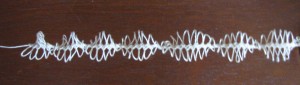
Again, maybe an hour later I had about 5 1/2 inches of net “ground” (space-filler, as I understand it) and the pairs of green sock yarn against the lighter pink and yellow sets made a great double helix-style pattern among the back and forth of the pattern.

Length of net stitch bobbin lace still on pins

That's a LOT of pins, my friend

Close up view of end of net lace peeking through the forest of pins

I promise, there's lace in there!

What’s relatively frustrating about this little exercise was that I understood the basic stitch movements before starting the crown lace–what? 2 weeks ago?–but it just wasn’t fitting into my head right. I’m still not 100% ready to tackle the crown lace yet (it’s still set up on it’s towel and hanging out in the Abyss, waiting for it’s turn and my bravado), but I do think these two starter laces showed me that I *can* do bobbin lace, and that was the point of trying, right?

Cloth stitch bobbin lace over net stitch bobbin lace

My finished pretties

Now that I’ve had some time to play with the cloth stitch I think I have a project in mind for it! (A wedding project, of course.) I’m going to need a considerable length of cord that is usually a braided sort, but I think it could be very nice if I take the 3 colors I was planning to use in the braided cord and made a single width of cloth stitch bobbin lace. It would certainly serve the same purpose (and it’s much easier than my inkle loom, is, I think).

Okay! Next week I have one more type of lace I want to give a go and then we will move on, I promise!

*except golf; apparently I have no aptitude for golf whatsoever

Into Every Lace, a Knot Must Snarl

64 Arts

Well, I may have just gotten in a wee bit over my head with this latest bit of lace I’m attempting. I even debated trying to whip up a different project (if I could in 1 evening) just to have something more substantial to show, but that would be a wee bit deceptive, and that’s not the point of this exercise.

It’s about new skills, and they don’t always come easy.

The first time I saw bobbin lace was years ago at a book fair (of all things). The artist had her pillow set up with all these pins in it, threads and bobbins seemingly everywhere but she was creating this amazing lace with so much detail.

(All of this being pre-blog and no camera permanently attached to my face–seriously, where is that cybernetic implant?!)

So when I hit the lacemaking art, I was super-jazzed about having the push it gave me to actually try out bobbin lace for myself.

And I thought the toughest part was going to be finding the parts and pieces I needed without spending a fortune!

Because, really, how hard could the rest of it be?

And now we’re back to the in over my head-ness of it all.

The supplies turned out to be surprisingly simple to cobble together:

  • I used a folded towel for my “pillow”,
  • I had plenty of pins and thread already in my stash,
  • and I downloaded a free pattern from Jo Edkins’ Lace School.

That same website had not only the best instructions I’ve found online but also a great tip that a reader had sent in about using pencils as bobbins–and I had plenty of those around the office–but I wasn’t sure about how long they were and keeping them from rolling around on the pillow.

Then I was wandering through Hobby Lobby–as you do–I spied these great party picks that I thought would do just great and, yeah, they look right.

In fact, if you look at my set-up, you’d think I knew what I was doing:

A good start to bobbin lace, but that's all

And, yeah, the set-up instructions all made great sense. And after a couple of false starts I managed to set up the foundation row that joined all the individual loops hanging on the starter pins.

But after that I got stuck.

I understand how to do the different stitches (again, great instructions from Jo Edkins, including little animated bits for the visual learners among us), just not how to get from point A to point B (or, rather, pin A to pin B). It probably doesn’t help that I’ve picked a simple-but-not-starter pattern to try and learn with, but I’ll soldier on and give it a bit more study and I’m sure whatever I’m not getting will click sooner or later.

Hopefully by next week!

When’s the last time you found a project that really challenged you?
Did you see it through or change gears? 

Small Movements and Quiet Time

64 Arts

First of all, I’m having so much fun with this particular art and I’m pretty doggone impressed by the crochet lace bag that I’ve continued to work on.

Unfortunately (for my to-do list of massive proportions) I wasn’t feeling so hot this weekend and spent most of it staying as still as possible, holding down a corner of the sofa, watching DVR’d shows for company. I’m still not sure what I did that made moving much or even breathing so painful, but it gave me an excuse to rest. (Which I sometimes need. And I seem to be all better now, so no harm done!)

And while I rested, I spent time with small thread and my smallest crochet hook.

First I tried out a new-to-me technique called Hairpin Lace.

The basic lace is made on a loomor frame. You could make one or fashion one from knitting needles and scrap wood, but a basic frame will run you all of 3.50 at your local craft mega-mart (or just under $6 at the affiliate-link, above). Named, more than likely, for the u-shape of the early looms/frames and they’re resemblance to old fashioned hair pins, this basic lace uses, again, just a chain stitch and a single crochet and some rhythmic turning and wrapping.

Hairpin lace on loom

But what are you supposed to DO with it after it’s made, I wanted to know. Frankly, it didn’t look all that impressive. Though I will say that the skill comes in being able to keep the “staple” (the row of stitches that hold the loops in place) in the absolute center of the loom.

hairpin lace test

Off I went to the Internet for inspiration. Apparently if you join a lot of strips of hairpin lace together, side by side, you can get some nice shawls and scarfs. I’m not really a shawl or scarf sort of person, but I did perk up when I found some lace edging instructions (handmade trim!) and a neat bookmark that made for a quick project.

Hairpin Lace bookmark and trim

Unfortunately the trim pattern seems to be incomplete (such is life) but even unfinished it looks pretty interesting. I’m still not convinced I couldn’t do more with it while still on the frame by repeating some stitches here or there, but for now I’ll just keep experimenting with trim.

Oh, and if you find you just like the practice of making the hairpin lace, it twists so nicely of it’s own accord that it could make for a really pretty chandelier or mobile decoration. Maybe some spray starch to keep it from wilting too much?

Hairpin Lace doing it's own twisty thing off the loom

Anyway, back to the original crochet lace bag I started over a week ago. After finishing the 2 smaller shamrock motifs for the front of the bag, I got to try my hand at the roses. Oh, these are nice little roses here, and it occurs to me that this part of the pattern may just have  a use in wedding projects down the road. But I digress!

After the rose motifs were complete it was time, finally, to put it all together and see how badly I screwed it up (self-deprecation is a bit of insurance against catastrophe, right?).

While it took a couple of false starts to figure out the best way to do the joining picot stitches, I finally got the hang of it, made it all work, and, viola! It’s a pouch:

Irish Crochet Bag Progress

What was left was only the top edging (done!) and the decorative balls and cord/strap. And the decorative balls? Need 18 made. I did 4 before my fingers felt like they were going to fall off so I stopped for the night. Now I’m realizing that I might run out of this color of green before I’m finished. Hopefully I can get the balls done. If so, I can see doing the strap in ivory. Maybe even some of the balls. We’ll see.

I’ll keep you posted!

1 Hook+3 Stitches=Fabulous

64 Arts

I originally learned to crochet when I was 7 or 8; my grandma taught me when we were home for a visit. She showed me the basics and set me up with some acrylic yarn and a hook and I had fun making granny squares that visit and all the way home.

The only problem?

That’s all I knew how to do. And over time I forgot some of the fiddly bits (mainly in regards to turning the work or starting new rows) so I’d just wing it. Most of the time that was okay–after all, I was just making big, doily-ish squares to go on my nightstand or attempting some Barbie clothes, certainly nothing important. But then one time I tried to make a blanket with what little knowledge I’d retained…

A green and white crocheted throw of concentric squares that tilt a bit with each round

That’s not a trick of the camera, my concentric squares really are tilting.

I’m not sure I could do that again if I tried.

The other issue I had with the just-enough-to-be-dangerous-to-a-skein-of-Red-Heart knowledge level was that I couldn’t read crochet patterns. They looked like calculus to me, all sorts of abbreviations and symbols.

Of course, once I taught myself to knit at age 26, suddenly those crochet patterns made sense, but I’d forgotten most of what I knew.

So when this week’s task was to find and actually try a crochet lace pattern, I was a little apprehensive!

Luckily, though, I managed to find a very neat bag pattern from a 1913 pattern book of which reproductions are now for sale but this sample pattern was not only free, it required only 3 stitches: chain, single crochet and double crochet.

And since this pattern required a certain amount of precision, I did look up some instructions for the latter two just to make sure I was doing them correctly.

Wanna see how I did?

shamrock-patterned crochet panel

This is actually the back of the bag (I found out as I was working ), though it looks kind of neat just on it’s own as a doily or something, don’t you think? The front, what’s pictured above in black and white, is made up of 4 panels: 2 rose and 2 shamrock; the back is just a shamrock panel with a bunch of extra rows around it so it’s great practice for the corner “petals” for when you get to the front. Once I’ve finished the front panels I’ll use the picot (the bobbly connector bits) pattern to join all the bits together and then work the top band and trim.

So far I’ve completed the back and almost finished one of the front shamrock panels and, I have to say, I’m having so much fun with this one that I’ll very likely finish it just to see how it looks. It’s not perfect, of course, but it’s pretty damn good for a virtual novice like myself. Maybe I’ll even enter it in the state fair 😉

At any rate, a few notes about crochet lace–consider this a mostly-pro list with only a few cons, comparing it to knitted lace.

  1. Generally you’re only working with one stitch (i.e. loop on the hook) at a time, so there’s less chance of disaster, I think, than in knitted lace.
  2. Because you’ve only got that one stitch, though, it’s easy to set the work down and then go off in the opposite direction when you pick it back up again. *cough* not that I’d know anything about that *cough*
  3. When you’re working with a loop of chain stitches–like at the beginning of the shamrock centers–and the pattern says to put 27 stitches in a ring of only 12 chains, that’s a sign to not crochet into the individual chain stitches but to treat the loop as one big stitch and stitch AROUND the chain loop. This is, thankfully, one of the few things I did learn from those years of granny squares.
  4. Lace crochet requires creating bits of work and then securing it in places to create the net or pattern; “catching” is how this pattern describes that attachment period and while I tried, at first, with a slip stitch, it wasn’t looking right; use a single crochet into the caught stitch and you’ll be golden.
  5. It’s tough to watch television and do a project like this–whereas a lot of knitting I can do with only half an eye on the work, lace crochet requires a lot more direct supervision, so try for music, an audiobook or a show you know well enough to just listen to while working on a pattern like this.

After this fairly successful foray into something I was more than a little intimidated by, I’m now wondering if I could crochet my own lace should I decide to make my own wedding dress!

Are you going to give this pattern a try?

The One Time You WANT Holes in Your Knitting

64 Arts

That’s right, friends, we’re moving from one needle-art to another and starting off the topic of lace!

26 Lacemaking

Crocheting thread or vegetable fibers to create a net, showing, with holes and crocheted areas, patterns of birds, animals, temples, houses, etc.

And even though this art specifies crocheting, I’m going to start with knitted lace because that’s what I’m slightly more proficient at.

Among knitters there seem to be two camps equally divided between two impressive skills: cables and lace. Cables are, of course, those patterns featuring a braided look like on the bulky fisherman’s sweaters and so forth whereas lace is the art of putting holes exactly where you want them. Both are complicated in their own right, but I’m fantastic with cables and lousy with lace.

Well, not altogether lousy, just not as skilled–but I’m getting better with each project.

For instance, years ago I was involved in a shawl swap and received this lovely, gossamer wrap as my gift.

A sage-green knitted shawl

It’s beautiful, don’t you think? And at over 6 feet long I shudder to think of how long it took her to knit!

This Braching Out scarf pattern from knitty.com reminds me of it and says it’s fairly easy to knit. Maybe I’ll give it a whirl next time I’m looking for a project.

For that same swap I attempted to knit my partner a similarly lacy shawl only to repeatedly get off-pattern. After at least 3 restarts (but possibly more like 10–I’m stubborn, if not always skilled) I gave up that pattern and stuck with my strengths: I knit a very warm and dense shawl in shades of yellow, orange and red and, yes, it included cables. Though I likened the finished product to a fuzzy, cabled candy corn, my swap partner swore she loved it.

One of these days I’ll try that sunflower-lace pattern again. Maybe.

But I’m not completely thumbs when it comes to lace, I just need a simple pattern to follow and even I’ve been known to produce pretty, functional and lacy fiber objects. Like this 6-stitch lace pattern that I made into a lightweight shrug that works fairly well as a “stunt shrug” when I try on wedding dresses, to see how they’ll look with a cardigan or other sleeve contrivance.

Lace shrug

Perhaps the project I’m most proud of, though, is this lace/net/mesh (all boils down to the same thing in knitting, really) bag that is perfect for trips to the farmers market as it stretches to accommodate a week’s worth of veggies when the shopping is good. It’s a variation on the Itsybitsy bag from knitty.com (I made, I think, half again as many rounds of the mesh portion to make a deeper bag, but not as wide as the Kitchen Sink version of the pattern).

Knitted mesh/lace shopping bag

In knitting lace, the hole-making stitch is generally a yarn over–abbreviated YO in patterns–and something new knitters accidentally do as they learn: all it means is to wrap the yarn around the needle between two existing stitches, creating one from nothing. With nothing to anchor it below, it makes a hole when you come back around and knit (or purl) this yarn over like any other stitch. In order to keep the right number of stitches and not have the incredibly widening object happening on you, it’s generally called for the knit or purl two stitches together for each added yarn over.

It’s a simple thing, true, but with each inventive way of spacing and treating those “extra” stitches, the beautiful lace patterns come out.

Of course, there’s also “cheater’s lace” as I like to call the practice of knitting rather small yarns on plenty-big needles–all of your stitches get spaced out pretty evenly so it looks like lace without the yarn-overs!

If you’re interested in trying your hands at knitted lace, both of the patterns I’ve linked in this article are good starting points (well, okay, one I’m guessing on, but it seems safe enough if you remember which line you’re on). Two things to keep in mind, though:

  1. Knitted lace often shows off best in single color knitting. Self-striping yarn is fabulous for socks and scarves, but can obscure a delicate pattern and make it harder for new knitters to read the pattern when they’re also trying to distinguish the color changes.
  2. Always deploy a safety net! Once you’ve finished a pattern repeat (or a few if it’s a pattern of only a couple rows at a time), stop and thread a length of contrasting yarn or even dental floss through every stitch on your needle before beginning the pattern repeat again. This way, should you get turned around or off a stitch a few rows up, you can safely frog (aka rip-it! rip-it!) back to your safety net/line and know exactly where to start again.

So, are you willing to cast on a new lace project for the new year? Whose ready to be daring!