A Day at the Faire

Nibbles

Renaissance Faire EntertainmentA couple weeks ago Todd and I, along with our new friend Andrea, traveled over to Pensacola to check out the Gulf Coast Renaissance Faire for the day. Thanks to a convenient time-zone crossing we made it to the Faire-grounds (a 3-hour journey) in just over 2. Talk about time travel!

First we happened on a talkative blacksmith demonstrating her process of making a simple bar of steel into something useful and lovely. There were several vendors throughout the central area of the Faire and we spent most of the first hour or more perusing their wares. It reminded me of a cross between a craft fair and Merchant’s row at an SCA (Society of Creative Anachronism) event.

In addition to various retailers, there were five stages set up for entertainment. There were continuous belly-dance performances in Arabia, variety acts on several stages and a field with fencing demonstrations and, yes, actually jousting by riders on horseback.

Reminiscent of a trip to Medieval Times, the spectators were divided into cheering sections for each of the combatants as the riders jousted and then competed in a series of skill exercises for points. It was quite breathtaking to watch–the charving hooves, the splitting of wood upon steel armor. Whew!

There was also a display of falcons and other birds of prey, including a hawk that chose to go on a little side adventure of his own.

It was quite a day.

But, of course, the question you may be asking yourselves is: what did we eat?

Ringing the Faire were all manner of food carts, most of which you’d see at any carnival or local festival: corn dogs, funnel cakes, burgers and fries, chicken sandwiches, popcorn, slushies, etc. Kebabs were available at many stands and they were, at best, the most close-to-authentic food available.

We, however, opted to order from Phil’s Mediterranean–they at least didn’t have your standard carnival truck but were sporting some inventive decorations and atmosphere. Granted, the gyro-meat that I ordered on my “gypsy plate” (brown rice and lentils seasoned with almonds and cranberries and topped with Greek-style salad) was of a style invented in the 19th century–well after the end of the Middle Ages; the most authentic ingredients of the dish were almonds and lentils.

And the turkey leg that Todd just had to order? Turkeys weren’t introduced to Europe until the late 1500s–kinda pushing it for a common Medieval food.
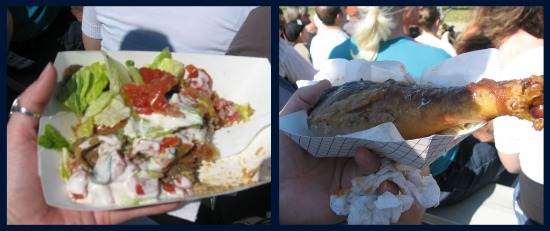
Renaissance Faire Food

What IS Medieval Food?

Trade was big business in the Middle Ages, but even with a relatively colder climate than we have now, long-distance trade of meats and vegetables wasn’t very efficient. Folks ate incredibly local, very little went to waste, and even though basic preservation skills like smoking, drying and salting were known and used, food was fresh more often than not. Spices, however, traveled well and were very expensive so were perfect for rich houses to show off their wealth to guests. Vegetables were not as uncommon as many think, though they were boiled or roasted more times than not.

Strangely enough, turducken is incredibly close–in theory, at least–to a lot of the medieval food I’ve made and studied. The cooks of the Middle Ages (those of the wealthy houses, of course) really liked the idea of stuffing a large animal with all sorts of smaller foods and roasting them all together. One of my most well-received lamb dishes is based (and by that I mean scaled down to a normal kitchen’s demands) on an Andalusian recipe that called for an entire ram to be stuffed with stuffed small poultry, meatballs and sauce of almonds.

This experience got me thinking: how much fun would it be to have a Medieval Cooking Challenge like the Indian one I participate in each month? So I’ve started one! If you’re curious about Medieval food and want to try out authentic recipes from long ago, check out the Medieval Cooking Challenge page and sign up! I’ll be sending out the first recipe for the challenge on April 1st!

ICC: Suruttai Poli

Nibbles

Another month, another installment of the Indian Cooking Challenge when I gamely attempt a cuisine quite different from my own, usually blunder somewhere along the way but still manage to come up with something tasty. This month’s suggestion came from Nithya and we made Suruttai Poli–a rolled dough with a sweet nut center.

Suruttai Poli

Suruttai Poli

As usual, I had to adjust some of the measurements but this time absolutely no ingredient substitutions were needed. Technically, at least.

Suruttai Poli

For Dough
1.25 c All-Purpose Flour
a pinch Salt
Water
Frying Oil
For Filling
1.25 c Roasted chickpeas
1.25 c Sugar
1.5 tsp Ghee
20 Cashews, chopped
1.5 Tbsp shredded Coconut
1.5 tsp ground Cardamom

Please don’t turn away at the thought of sweet chickpeas (aka garbanzo beans). I was a bit skeptical, myself, but it makes an amazing base for the filling. Trust me and try it for yourself. This is also where the not-technically-a-substitution occurs and where my results end up vastly different from the original. More will be revealed.

Making the Dough

Suruttai Poli Dough Combine the flour and salt in a medium-sized bowl and mix together. Add water, about a teaspoon or two at a time, and stir until a shaggy dough starts to form. I found the best way to do this was just to stand at the sink with a little trickle of water running and pass the bowl under it periodically as my hand tossed the ingredients together. It prevents over mixing and over-watering. 

Knead it a little bit until it holds together fairly well, form into a ball and let the dough rest for at least 30 minutes. I realized I was almost out of frying oil so had to run to the grocery store so mine sat for closer to an hour. Made no difference than I could tell. If it’s going to be quite some time, though, you may want to cover it just so it doesn’t start to air-dry on you.

Making the Filling
Roasting chickpeas for the filling And here’s where I unintentionally detoured. The original recipe called for Roasted Gram, which is chick peas, but I didn’t want to start with dry so I opted for canned. I drained and rinsed the beans, spread them out on a foil-lined cookie sheet and roasted them in the oven for 20 minutes or so. It seemed like a good idea at the time.
The chickpeas and sugar Then the instructions said to powder together the roasted gram and the sugar. Hmm. Canned chick peas, although roasted, do not powder. They mush. This was fine by me, though, as I’d burnt out the motor on my food processor with the last ICC recipe and had yet to replace it. Mushable gram meant I could go low-tech and bash them around with a rolling pin before adding the sugar. It worked.
Toasting the cashews and coconut Heat the ghee in a small frying pan and add in the cashews and coconut, stirring over medium heat until both are lightly toasted.
The filling ingredients combined Combine the chickpea/sugar mixture with the contents of the frying pan and the cardamom and mix together well. The first thing I thought when it was all put together was Apple Jacks. Todd thought Fruit Loops. Now, I’m betting Big Cereal isn’t using an expensive spice like cardamom in their breakfast formulas, but it made me wonder what chemical combination produced that same aroma.

The filling is done, you can set it aside until needed. Realizing, around this time, that the filling is probably supposed to be more of a dry powder than the paste I ended up with, I put my filling into an pastry bag to make the filling step, ahead, easier to accomplish.

Making the Poli

Rolling out the dough Divide the well-rested dough into 24 equal portions and roll each out to about 4 inches on a floured board, the rounder the better. They will be thin but that’s what you want. Too thick and they will puff like poori and make it tough to finish the dessert. 

Let the rolled dough rest for another 10 minutes while you get everything ready for the final steps. I laid mine on sheets of wax paper (counter space is at a premium) and stacked them 4 to a layer. This worked out okay, though some wanted to stick. It’d probably be best to give them a bit of airing time before covering them up, just to make sure it doesn’t happen to you.

Frying, Filling and Rolling the Poli

Heat a small amount of oil–maybe an inch, if that–in a small frying pan. Slide a round of dough into the hot oil, give it a second or two to cook then flip and remove. You don’t want them to get crispy or to brown as then you’ll never be able to roll them.

Immediately top the fried dough with “3 spoons” of filling. The 3 spoons makes more sense if your filling is powdered though I really loved my paste filling–I could squeeze it out along one side and go on to the next step without worrying about spilling anything.

Starting from the filling end, roll the dough into a tube, enclosing the filling, and place them seam-side down. You’ve got to work fast or the dough will firm up on you and you’ll end up with shards instead of a cigar-shape. As they cool, the poli will firm up.

Tower of Suruttai Poli

Now, I would never be so bold as to call my accident with the filling an improvement on a traditional recipe that I know nothing else about. However, the filling step was much expedited by the use of the pastry bag (only possible since the filling was a paste) and I’m a bit puzzled how you eat one filled with powder without it becoming like a pixie stick and spewing sugar everywhere.

Because of the speed of finishing them, I think it would be best to have 3 people at that step: one to fry, one to fill, one to roll. That way you can just bang out enough for a party in no time flat.

To see how other ladies (who, ahem, actually know what their doing when it comes to Indian food) made Suruttai Poli, check out the linky over on Spice Your Life.

Once More for the French Chicken

Nibbles

I seem to be working on a theme, here, but it wasn’t intentional. Just one of those one-thing-led-to-another processes. This will, however, be the last dip into Escoffier for a bit. For me, the egg definitely came before the chicken breast, and now we’re tackling the whole bird; answering the important question:

Why did the chicken go into the oven?

Because there was a blanket of butter waiting for her, of course.

Roast chicken has been experiencing a bit of a revival among foodies. It seems that something so simple and satisfying still takes some sort of skill to pull off well. To that end, I submit Poêling (pronounced PWAWL-ing).

Poêling is roasting but it’s a particular type of roasting. Here’s what the chef, himself, has to say about the method:

Method for Poêling:

Place a layer of Matignon in a deep heavy pan just large enough to hold the piece of meat or poultry; well season, place the item on top of the vegetables and coast well with melted butter. Cover with the lid, place in a not too hot oven and allow to cook gently, basting frequently with the butter.

When cooked, remover the lid and allow the meat or poultry to become well coloured then remove it to a dish and keep covered until required.

Add sufficient clear well flavoured brown veal stock to the vegetables which should not have been allowed to burn, bring to the boil and allow to simmer very gently for 10 minutes. Strain, remove the fat carefully and send the gravy in a sauceboat with the meat which would normally be surrounded with a garnish.

So there’s the big secret: basting with butter.

Now, before anyone starts to talk about a certain Savannah food personality who will remain nameless, please note that I used less than 2 sticks of butter for this recipe and that the resulting gravy is de-fatted before serving. There is a difference between using just enough butter to get the job done and pouring the butterfat straight into ones arteries.

Let’s Poêle, Shall We?

Preheat our oven to 375° Fahrenheit and melt 7 oz of butter ( 1 3/4 sticks) and set aside.

Matignon igredients Prepare the Matignon. Combine your basic mirepoix (2 parts onion, 1 part carrot, 1 part celery) with ham, bay leaves and thyme and sweat together in butter until the ham begins to color a bit and the onions become translucent. 

I was, unfortunately, out of celery that evening so substituted a green bell pepper with no ill effects.

Matignon in the bottom of the casserole dish Add the prepared Matignon to the bottom of a roasting dish. My small clay baker was just a smidgen too snug and the turkey roaster overkill, so I went with a casserole dish deep enough to accommodate the bird, Matignon and the drippings and added a foil cover before placing in the oven.
The seasoned and butter-basted chicken ready for the oven. Rinse and pat dry your roasting hen (or whatever else you’d like to poêle). Tuck the wings behind the back (to prevent burning) and truss the legs closed. Season with salt and pepper (most of the flavor comes from the basting liquid and the Matignon below) and place on top of the Matignon.

Baste the bird with the melted butter, cover with either the lid for the roasting dish or tented foil (to prevent the skin sticking to it) and place into the oven. Baste again every 15-20 minutes until the thigh registers 150° Fahrenheit. By this point you should have run out of the melted butter and be basting with the liquid from the bottom of the roasting dish.

Finished Poeled Chicken Remove the cover from the bird and place back into the oven until the thigh registers 160° Fahrenheit. The hope is that in cooking those 10 additional degrees the outside of the bird has turned a lovely golden brown. Here’s the thing, though: it may be more golden, less brown, but take it out anyway because it’s better to have a pale, tasty bird than a pretty, dried out one. All told it took around 2 hours to cook our little 4-pound chicken.
Matignon and drippings being simmered into gravy Set the poêled chicken aside and reuse that foil to cover it, keeping in the heat while you make the gravy.Pour the Matignon and pan drippings back into your pan from earlier, add beef stock (no real measurement here, but I’d say no more than a cup–you should have plenty of liquid from the pan to work with, too), bring to a boil and then reduce to a simmer for 10 minutes.
Straining the Matignon from the gravy Strain out the vegetables, ham and bay leaf from the gravy and de-fat what remains. De-fatting can be accomplished by skimming or dipping the edge of a white paper towel onto the top of the liquid and letting it absorb the fat (though that way can take a little while). One of those fat-separating measuring cups would really come in handy with this step!

Check the finished gravy for flavor (the seasonings from the poultry should make additional salt and pepper unnecessary, but it’s always good to check) and serve.

Poeled Chicken and Gravy over Quinoa, with Green Beans

Poêled Chicken and gravy over Quinoa, with Green Beans

This made for a delicious Sunday supper for us and the carcass went straight into the freezer for gumbo in the not-too-distant future.

It All Started With Some Asparagus

Nibbles

I had picked up some beautiful asparagus at the farmers market and was trying to decide what to do with it. As great as it is steamed with a little salt, olive oil and lemon juice, sometimes you want to step out of your own little rut.

That’s when I remembered Marengo.

There are many things I remember from my 2 years at CCI, many excellent recipes, chefs and fellow students that I cherish. French Classical may not have been my favorite class, but at least it wasn’t at the bottom of the list (that honor goes to Garde Manger, in case you were wondering). One recipe in particular, though, does stand out from that class: Poulet Sauté Marengo.

And it used asparagus. At least, that’s how I remember it from class (the book says nothing about it, but that’s beside the point). So I decided that it was a perfect mid-week dinner.

Next time I decide to relive French Classical, it will be on a weekend.

Poulet Saute Marengo a la Scraps
Poulet Sauté Marengo (a la Scraps), with Duchesse-style Potatoes

Again, Escoffier doesn’t write recipes like we’re used to. Here’s his version of the dish:

3225 Poulet Sauté Marengo

Season the pieces of chicken and sauté them in oil. Drain off the oil and deglaze the pan with [5 oz] white wine and reduce by half. Add the roughly chipped flesh only of 2 tomatoes, or 1.5 tbs tomato purée, a touch of crushed garlic, 10 cooked small button mushrooms, 10 slices of truffle and [5 oz] Jus lié.

Finish cooking together then arrange the pieces of chicken in a deep dish and coat with the sauce and garnish. Surround with 4 heart-shaped Croûtons of bread fried in butter, 4 trussed crayfish cooked in Court-bouillon and 4 small French fried eggs. Sprinkle with coarsely chipped parsley.

I, of course, made a few adjustments both to ingredients and procedure. One was to substitute roasted red bell peppers for the tomatoes (it lists flesh-only, by the way, to mean leave out the seeds) and skipped the mushrooms and truffles altogether (the former as Todd’s not a big fan and the latter for lack of availability). The other was to make the sauce with the chicken still in the pan. I have two reasons for this:

  1. I despise the practice of cooking something and then letting it sit out on the side to cool (and toughen) while the rest of the meal cooks. In most cases I find it completely unnecessary. We call this hokey-pokey chicken at home and avoid it whenever possible.
  2. Cooking the sauce with the meat, when possible, adds additional flavor to the protein in question. Who wants more flavor? We do. I bet you do, too (otherwise you wouldn’t be reading this).

Preparation is key with many dishes and this recipe was popular back when there were full kitchen brigades to handle the various steps. Thinking ahead will save you much anxiety when you’re trying to get dinner onto the table.

Start by chopping everything you’ll need for the entire process: chop the peppers or tomatoes and mushrooms if you’re using them, crush the garlic, stem the asparagus and shape the croûtons.

Next, make the Jus lié that you need for the sauce. Jus lié is a shortcut (even the great ones used them!) for demi glace–the concentrated veal stock that adds so much flavor. It’s gravy. Start with double the amount of stock you need (in this case, a cup and a quarter of beef stock) and reduce it (by boiling) by half. Make a slurry of cornstarch and water and whisk this into the reduced stock, cooking until it thickens and set aside until needed.

Steps to Marengo

Steps to Marengo--it sounds like a dance, and that's NOT far from the truth!

French cooking is notorious for being both complicated and messy. Remember what I said about kitchen brigades? Precisely. I prefer to combine steps and reuse pans whenever it won’t hurt the finished dish in order to keep my kitchen from looking as much of a wreck as it could.

For instance, the croûtons called to be cooked in butter. I figure I’m going to need a pan for the chicken, later, and it uses oil (olive, in my house), so why not start the croûtons in oil, first, set them aside to cool, and then move straight onto the chicken? No good reason not to, so on we go.

The chicken is seasoned with just salt and pepper–the flavor (as with many French dishes) comes from the sauce. Get them nice and golden brown on each side and then add the wine to the pan and deglaze it all together. Once the wine has reduced, push the chicken to one side (in this case, I stacked one pair on top of the other) and add the sauce ingredients to the pan until combined. Once the sauce is set up, spread the chicken around so that everything gets nice and cozy together and let it cook while you handle the rest of the ingredients.

While the chicken and sauce cooks, get your steamer set up for your asparagus and combine the crawfish tails with a little stock and seasonings to perk them up. I allowed 6 per serving, so about half a cup of tail meat. Set the crawfish on low—they’re already cooked, we just want them nice and warm.

Oh, right, now you need to do the French fried eggs! Go ahead and make those up while the sauce sauces and the asparagus steams. The idea is that everything comes together just before serving.

Building the Plate

Building the Plate

Now, I’m not usually one for architectural food (a dish piled so high you have to dismantle it before you can eat it) but, in this case, the stacking serves a purpose.

Beginning with the croûton, build the dish in layers: a croûton, a chicken breast, a large spoonful of sauce from the pan, asparagus spears, the crawfish tails and a single French fried egg. Add your side and you’ve got a beautiful dinner to share with someone special (or keep all to yourself—no one’s going to judge you, here).

Now, the point of the stacking rests solely on that French fried egg. See, you make your first cut down the center of the tower, egg to toast, and the yolk flows down, combining all the flavors into one lovely, rich sauce. It’s simply amazing.

An Aside on A Side (dish)

Originally I was going to go all out and make Tourné Potatoes as a side dish for the Marengo. Tourner is a cutting style that makes the vegetable look like a little football with 7 equal sides and blunt ends. A favorite for knife skills exams and fru-fru potato salad.

Not only is it a slightly wasteful cutting style (unless you’ve got something to put those peelings into afterwards) it’s also a pain in the ass, as I was so quickly reminded when it took 30 minutes to get a dozen cut and they weren’t exactly perfect.

Tourner Potatoes

the trimmed potatoes, a tourné knife, and the "discards"

So I just diced the rest of the potatoes and planned to par-boil and then saute them. A bit of a punt from the original plan, but it would work.

Well, it would have worked had I not let them boil a smidgen too long and they started to mash on their own when I went to saute them. So, out came the butter and milk and some garlic and mashed they were.

But mashed potatoes would look so… wrong beside the Marengo that I went for a Hail Mary: I turned on the oven, grabbed a pastry bag and humongous open star tip and piped out the potatoes Duchesse-style. 30 minutes in the oven and their little top edges were just starting to brown.

(Note: Duchesse Potatoes also include an egg yolk to be correct, but mine had olive oil from the botched sautéing and were fine.)

The French Do Love to Fry

Nibbles

Well, I can’t speak for the country as a whole, these days, but back in the heyday of Classical French cuisine, frying was THE thing to do.

Escoffier’s The Complete Guide to the Art of Modern Cookery is not a cookbook for the beginner. It’s less cookbook and more, as the title suggests, a guide. It assumes the cook has quite a bit of preliminary experience with basic and advanced preparation methods. With over 5,000 “recipes” (mostly paragraphs telling you what to do, but not how and with only a few measurements given) it’s a treasure trove of all that haute cuisine was back in the early twentieth century.

Rambling through old school notes I was reminded of a particular dish that was a lot of fun to make, but it required yet another specific skill: How to Fry an Egg.

As most folks can “fry” an egg quite sufficiently, you might wonder why this is considered a special skill that takes practice and a bit of finesse to complete well.

Here’s the word from the man, himself:

1294  Oeufs Frits — French Fried Eggs

In the long list of ways of preparing eggs, that for fried eggs is relatively insignificant when compared with others. Although fried eggs are used to a great extent for breakfast in England and America, correctly speaking they are Oeufs a la Poele or pan-cooked eggs; in both countries the true fried egg is virtually unknown.

So, if our sunny side ups and over-easys aren’t technically fried eggs in the French sense, how do you fry an egg?

Deep fry it, of course.

Even our chef-instructor was a bit puzzled by how to go about it. Early attempts yielded messy results until he hit upon the seeming trick: to get the oil moving before the egg enters the picture. This makes forming a neat, fried egg with the white enveloping the yolk (which is left liquid) a much easier task.

How to (French) Fry an Egg

  1. Start with a small pan, like an omelet pan, with enough depth to contain an inch of oil without overflowing. Heat the oil until just before it begins to smoke–you’ll notice the oil “walking” along the pan, give it a minute or two more before proceeding. Oil that’s not hot enough will cook the yolk before the whites are sufficiently browned while oil that is too hot will, predictably, burn the bits of egg white that you want to coax around the yolk. Prepare a plate lined with paper towels to drain the eggs on once cooked.
  2. Break an egg onto a saucer. You’re going to fry these one at a time and cracking it directly into the oil encourages splattering and could cause burns. You can season the egg with salt and pepper now, or wait until it’s cooked to season it; I prefer to do it after frying, Escoffier prefers before.
  3. With a chopstick or wooden spoon, stir the oil rapidly to get it to spin a bit. This turned out to be the secret to making this task easier as the whirlpool effect helps keep the eggs from spreading too much once added to the hot oil.
  4. Slide the egg from the saucer into the spinning oil.How to French Fry an Egg
  5. Continue stirring the oil, a bit more gently, and scoot the edges of the white closer to the egg yolk.
  6. As the egg starts to firm up, fold the white over the yolk and keep turning the egg until it sticks.
  7. Continue to turn the egg as it starts to brown along the edges. It’ll puff up a bit but should not explode.
  8. Once the egg seems sufficiently done, gently lift it from the oil and transfer it to the towel-lined plate to drain. Repeat with as many eggs as you need for your dish and serve ASAP!

To those not used to this sort of fried egg, it’s like a cross between a poached egg and one sunny-side up. It’s not greasy, despite being deep fried, and it’s a great option for the next time you’re feeling the Eggs Benedict craving.

Of course, I had a different recipe in mind when I wandered down the fried egg rabbit (chicken?) hole. Come back next week to find out what it was! (Though if you follow me on twitter, you might have already seen it!)