A Peek In the Pantry

Nibbles

A Peek Inside My PantryNot long ago, a new friend asked me a question that I did not have a ready answer for:

How do you stock a pantry?

The question stumped me because a) I hadn’t (ever?) given the matter much thought–it was just something that we did–and b) it really depends on how you cook.

Still, as the week went on I thought more and more about pantry basics and what tips I could offer her. And if I’m going to answer the question for one person, maybe there are more out there who could benefit from my answers.

Let’s take this group by group, shall we?

Canned Goods

We don’t use a whole lot of canned goods (we prefer frozen veggies to canned, for instance) but there are a few canned items that we keep around for convenience on a regular basis:

  • Beans (kidney, white and black–great for a dip or quick soup or stew when you haven’t had the forethought to soak dried)
  • Artichoke Hearts
  • Coconut Milk
  • Roasted Red Bell Peppers (which we use in place of diced tomatoes or any other tomato products, you might want to keep different types of tomatoes on hand in addition to a jar of pasta sauce if that’s something you’re likely to eat often)
  • Olives
  • Beef and Chicken Stocks
  • Peanut Butter and Jelly (even grown ups get those cravings now and then)
  • Tuna
  • Minced garlic (fresh may be best but we go through so much garlic, it makes more sense to buy it minced in a jar–a big one–than to chop it ourselves practically every night)

Grains, Pasta, etc.

Variety is always good here: grains can easily extend a smaller meal when unexpected guests arrive and are a healthy filler for hungry tummies or when comfort food is desired.

  • At least three shapes of pasta noodles: orzo or couscous, rotini or ziti and spaghetti or fettuccine–each type works with different types of sauces and there are plenty of other options available. Buying what you can find in whole wheat is a healthy alternative to the more processed varieties and something we look for.
  • Rice, both white and brown, along with arborio if you like risotto
  • Barley, quinoa or bulgur wheat (alternatives to rice and great additions to soups)
  • Lentils
  • Dried beans (the same variety as canned or in place of canned)
  • Oatmeal (quick/rolled oats, not instant, for baking OR breakfast; steel cut are also nice if you have the time to prepare them)

Dry Goods

This is a catch-all for whatever doesn’t fit anywhere else, really. Everything from baking supplies to breadcrumbs fall in here.

  • Flour (all-purpose at minimum, whole wheat, rice and gram flours are also nice to have on hand)
  • Sugars (white, brown–light or dark is mostly personal preference, no matter what the recipe says, and powdered will get you through most scenarios)
  • Baking soda
  • Baking powder
  • Salt (iodized is okay for the salt shaker but kosher is better for cooking)
  • Breadcrumbs (buy plain and season them yourself when needed)
  • Cornstarch
  • Cornmeal
  • Sliced bread or large tortillas for sandwiches

Oils, Vinegars, etc.

All fats are not evil, especially when used in moderation. They help keep your food from sticking as well as add and carry flavors. Vinegars and condiments add all sorts of flavor on their own and are worth keeping a decent variety around.

  • Extra Virgin Olive Oil
  • Peanut or Canola oil (for frying, mostly, if you deep fry at all)
  • Vinegars (regular is good for dying Easter eggs or cleaning; apple cider, rice, white wine and red wine are all wonderful for cooking with)
  • Soy Sauce (or Teriyaki sauce or both)
  • Mustard (we prefer brown or whole grain to yellow)
  • Mayonnaise
  • Ketchup
  • Relishes and chutneys (whatever sounds good, a couple to have on hand to spice up a basic dish)

Miscellaneous

Having covered most of the basics (at least that I can think of at the moment), there are things we keep on hand because we like them more than being necessities.

  • Raisins and other dried fruit (for topping salads)
  • Sunflower seeds or Pepitas (pumpkin seeds)
  • Croutons
  • Chocolate-filled Oreos (a decided weakness)
  • Doritos (Todd’s snack of choice)
  • Chocolate chips
  • Marshmallows

Beyond the Cabinets

Of course, dry goods, cans and boxes are only part of the picture. A well-stocked kitchen also includes the fridge and wherever you keep your produce.

Fridge Forward

You want to keep some obvious basics around and chilled for any recipe contingency.

  • Butter (unsalted sticks are the most versatile)
  • Milk (fat content or soy-substitutes are up to you)
  • Eggs (large eggs are the most common size called for in recipes)
  • Sour Cream OR Plain Greek-style Yogurt (we like the latter for health reasons and it’s easy to dress up sweet or savory)
  • Cream Cheese

And speaking of cheese, it’s good to have a few types around but which ones and what form to buy? We tend to buy shredded cheddar, mozzarella and grated Parmesan the most often; sliced provolone is Todd’s favorite for sandwiches. Of course, if you own a box grater and a knife you can buy blocks of cheese (which are usually cheaper than the pre-shredded or -sliced) and break them down yourself for greater flexibility.

Fruits and Veggies

Produce is going to depend on seasonality and what you’re cooking. We’re more than happy to buy frozen veggies when fresh isn’t as available, but we love the fresh the best. Fruits we concentrate less on (though Todd has to have his daily banana). Here are some to keep on hand no matter what (fresh or frozen is up to you):

  • Onions (yellow or white, mostly, with the occasional red onion thrown in for variety)
  • Potatoes (mealy and sweet for baking, waxy for boiling and mashing and red for roasting)
  • Bell Peppers, green and red
  • Celery
  • Tomatoes when is season (off-season fresh tomatoes have zero flavor and aren’t worth the money)
  • Lemons and limes
  • Ginger
  • Broccoli
  • Cauliflower
  • Green Beans
  • Green Peas
  • Romaine Hearts
  • Spinach
  • Kale
  • Apples
  • Bananas
  • Avocado

Some things you’ll only buy every now and then, others (like produce) will need constant replenishment. I didn’t even touch on spices because that’s a post all it’s own and a collection you’ll definitely build over time. And I wouldn’t suggest anyone take this list and buy everything on it in one fell swoop (that would be a serious budget-killer) but to build up to this level over time. If you do, you can make many meatless meals as well as transform any fish, shellfish or meat from boring to extraordinary.

50 Shots of America–Wyoming

Sips
Cowboy UP! Cocktail

Cowboy UP! (with sugar cookies and milk)

Dude, we’re up to the 44th state of the Union: Wyoming!

And no, I haven’t confused my states, I know we’ve already done California. I’m not talking surfing, here, I’m talking ranching! Dude ranches, specifically, the first of which was opened in 1879 in Wolf, Wyoming by the Eaton brothers (warning: music plays automatically). Back then, “dude” referred more to dandies than the burn-outs of the Bill & Ted/Big Lebowski era, which makes a lot more sense when you think about Dude Ranches being places for city folk to get away and “play West” the way kids play house.

So, what else is there to know about Big Wyoming? Well, that it is big, for one thing! It’s the 1oth largest state size-wise but it’s the 50th people-wise. Lots of room to spread out (at least on the 3rd that isn’t mountain ranges). There’s also lots of mining and beau-coup tourism (can we say major National Parks? yes, yes we can). On the agricultural side they’ve got beef, hay, sugar beets, wheat, barley and wool.

And then there’s the who Equality thing. With “Equal Rights” as a state motto I suppose it’s no surprise that they were the first state to give women the vote, to allow them to serve in previously male-only occupations (bailiff, justice of the peace) and even the first to elect a woman as governor!

Cowboy UP!

1 Tbsp Shredded Coconut
1/2 oz Dark Rum
1/2 oz Chocolate Liqueur
1/2 oz Hazelnut Liqueur

Muddle the coconut and the rum in the bottom of a mixing glass. Fill with ice, then add the chocolate and hazelnut liqueurs. Shake like a bucking bronco just outta the gate and strain into a chilled cordial glass (miniature bandanna optional).

Wyoming is, among other things, the Cowboy state and all I could think of after that was Cowboy Cookies: oatmeal cookies studded with nuts, raisins, chocolate and coconut. Of course, what goes better with cookies than milk? Unlike most of my drinks, this one doesn’t include any mixer so I’d suggest you chase it with a shot of milk or go ahead and pour it in–either way the drink is delicious.

50 Shots of America–Idaho

Sips

The Sweet PotatoWhat I know of Idaho is what I saw on the 5# sack of potatoes as a kid: what it’s shaped like and potatoes come from there. It’s one of the few states I could pick out on an unlabeled map, thanks to their simple but straightforward marketing plan. No surprise, there’s a lot more to our 43rd state than I realized.
After being excluded from the official boundaries of first Oregon and then Washington, The Gem State (so named as every known gem has been found in the state, including the rare star garnet) got it’s very own statehood on July 3, 1890. And, being mountainous doesn’t seem to to hamper it’s production of three varieties of wheat and close to a third of the country’s potatoes–the spud is the state vegetable, as one would presume, and the Annual Spud Day has been celebrated in Shelley since 1927.

The Sweet Potato

3/4 oz Vodka
1/2 oz Cointreau
1/2 oz Simple Syrup
1/4 oz Cinnamon Schnapps

Combine all ingredients over ice and shake, vigorously, as if you’re shushing down the mountainside. Strain into a chilled cordial glass.

It doesn’t taste like a sweet potato, with or without the buttery cinnamon topping, but it is sweet and, if you’ve got it handy, using potato-based vodka will make it that much more authentic.

A Day at the Faire

Nibbles

Renaissance Faire EntertainmentA couple weeks ago Todd and I, along with our new friend Andrea, traveled over to Pensacola to check out the Gulf Coast Renaissance Faire for the day. Thanks to a convenient time-zone crossing we made it to the Faire-grounds (a 3-hour journey) in just over 2. Talk about time travel!

First we happened on a talkative blacksmith demonstrating her process of making a simple bar of steel into something useful and lovely. There were several vendors throughout the central area of the Faire and we spent most of the first hour or more perusing their wares. It reminded me of a cross between a craft fair and Merchant’s row at an SCA (Society of Creative Anachronism) event.

In addition to various retailers, there were five stages set up for entertainment. There were continuous belly-dance performances in Arabia, variety acts on several stages and a field with fencing demonstrations and, yes, actually jousting by riders on horseback.

Reminiscent of a trip to Medieval Times, the spectators were divided into cheering sections for each of the combatants as the riders jousted and then competed in a series of skill exercises for points. It was quite breathtaking to watch–the charving hooves, the splitting of wood upon steel armor. Whew!

There was also a display of falcons and other birds of prey, including a hawk that chose to go on a little side adventure of his own.

It was quite a day.

But, of course, the question you may be asking yourselves is: what did we eat?

Ringing the Faire were all manner of food carts, most of which you’d see at any carnival or local festival: corn dogs, funnel cakes, burgers and fries, chicken sandwiches, popcorn, slushies, etc. Kebabs were available at many stands and they were, at best, the most close-to-authentic food available.

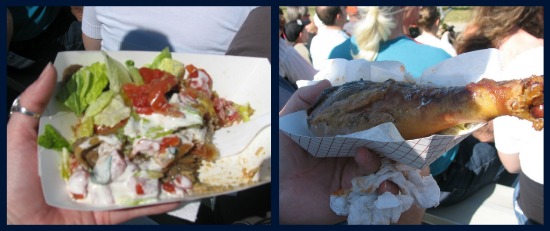
We, however, opted to order from Phil’s Mediterranean–they at least didn’t have your standard carnival truck but were sporting some inventive decorations and atmosphere. Granted, the gyro-meat that I ordered on my “gypsy plate” (brown rice and lentils seasoned with almonds and cranberries and topped with Greek-style salad) was of a style invented in the 19th century–well after the end of the Middle Ages; the most authentic ingredients of the dish were almonds and lentils.

And the turkey leg that Todd just had to order? Turkeys weren’t introduced to Europe until the late 1500s–kinda pushing it for a common Medieval food.

Renaissance Faire Food

What IS Medieval Food?

Trade was big business in the Middle Ages, but even with a relatively colder climate than we have now, long-distance trade of meats and vegetables wasn’t very efficient. Folks ate incredibly local, very little went to waste, and even though basic preservation skills like smoking, drying and salting were known and used, food was fresh more often than not. Spices, however, traveled well and were very expensive so were perfect for rich houses to show off their wealth to guests. Vegetables were not as uncommon as many think, though they were boiled or roasted more times than not.

Strangely enough, turducken is incredibly close–in theory, at least–to a lot of the medieval food I’ve made and studied. The cooks of the Middle Ages (those of the wealthy houses, of course) really liked the idea of stuffing a large animal with all sorts of smaller foods and roasting them all together. One of my most well-received lamb dishes is based (and by that I mean scaled down to a normal kitchen’s demands) on an Andalusian recipe that called for an entire ram to be stuffed with stuffed small poultry, meatballs and sauce of almonds.

This experience got me thinking: how much fun would it be to have a Medieval Cooking Challenge like the Indian one I participate in each month? So I’ve started one! If you’re curious about Medieval food and want to try out authentic recipes from long ago, check out the Medieval Cooking Challenge page and sign up! I’ll be sending out the first recipe for the challenge on April 1st!

50 Shots of America–Washington

Sips

The countdown of the last 10 states in the series continues with the northwest corner of the contiguous 48…

~~~oOo~~~

Caramel MacchiappleDid you know that when the powers that be in the Washington Territory petitioned for statehood in 1885, they wanted to be known as the state of Columbia? Congress, however, thought it would be too easily confused with the District of Columbia, the Nation’s capital. It’s ironic, then, that they didn’t have a problem naming it the State of Washington, don’t you think?

It might be a pretty big state, but around 60% of it’s residents are cluster in the Seattle metro area, and is home to some serious heavy-hitters in tech: Amazon, Google and Microsoft. It’s known for it’s apple orchards, boasts actual rain forests and is the birthplace of a little, hardly known coffee company 😉

I know not everyone is a fan of Starbucks. I love shopping local, including for my coffee beverages, but oh… oh I love the crazy caloric rush that is the Caramel Macchiato (Caramel Latte almost anywhere esle). And, like some sort of a joke, my coffee order is a bit complex: Venti Decaf Soy Caramel Macchiato.


The More Complicated the Coffee...

The More Complicated the Coffee...

But would coffee and apples taste good together?

Caramel MacchiApple

1 oz Coffee Liqueur
1/2 oz Sour Apple Schnapps
1/4 oz Caramel Syrup

Combine all ingredients over ice and shake like Mount St Helens getting ready to blow. Strain into a chilled cordial glass (or demitasse) and sip.

The tart of the apple goes extremely well with the smooth caramel and coffee mixture. The Swedish Fish-garnish is a nod to another local landmark: Pike Place Market where the fish go flying.

~~~oOo~~~

Only 8 more states to go!